Lindsey Wilson University Honors Students Serve Campus an Academic Feast
Lindsey Wilson R.V. Bennett Honors Program's fall symposium showcases a bountiful display of student research.
COLUMBIA, Ky. (11/25/2026) — Two days before Thanksgiving is celebrated in America, the Lindsey Wilson University community was treated to a cornucopia of academic presentations and research.
At the university's semiannual fall symposium, 17 members of the Lindsey Wilson R.V. Bennett Honors Program presented a bountiful amount of findings, discoveries and assessments on Tuesday, Nov. 24 in the Holloway Building's Katie A. Murrell Library. Even more impressive was that the students' work -- presented in the Thomas D. Clark Reading Room and the Keith Stearns Room -- raised a plethora of questions and suggestions for additional research, exploration and investigation.
During six panel presentations -- four of which were held concurrently -- students explored an abundance of topics that included the psychological impact of sports-related injuries, the media's coverage of Hurricane Katrina, the historical reliability of the ancient Israelites' exodus from Egypt, burnout among nurses, and a proposed business to clean headstones and cemeteries.
Many of the presentations had their origins as class assignments that evolved into semester-long projects, although one student planned a yearlong dive into an advanced algebraic concept.
Putting Katniss Everdeen on the couch
For some students, their project was born from personal experience, such as Aly Rae Greene '30, who suffered a season-ending injury while playing a flag football game as a high school junior. A member of the Lindsey Wilson softball team, Greene said she had to learn about an athlete's mental and physical recovery, which she explored in "Psychological Effects of Sports-Related Injuries and the Importance of Incorporating Psychology in Physical Therapy."
Greene, who conducted her research under psychology professor Jordan Greenburg, said her work will help her when she reaches her professional goal of becoming a physical therapist.
"Physical therapy during the rehab process must include the mental as well as the physical," said Greene, a psychophysiology major from Pleasant View, Tennessee.
Another psychophysiology major Greenburg advised, Emma Johnson '30, was driven to her topic, "What Alcohol Does to the Brain," because of a lifelong interest with the organ.
"The brain has always fascinated me," said Johnson, who is from Coxs Creek, Kentucky.
A third student mentored by Jordan took psychology on another path.
Ada Gass '28 put dystopian fictional hero Katniss Everdeen of "The Hunger Games" on the couch with her presentation, "Beyond the Girl on Fire: Understanding Katniss Everdeen Through Personality Psychology."
Gass' analysis: Everdeen is a complicated character.
"She is not simply a courageous heroine," said Gass, a nursing major from Columbia. "She is an example of how circumstances shape behavior."
Another slice of popular culture was examined by Sarai Collins '28, a human services and counseling and gender and cultural studies double major from Columbia. Under the guidance of English professor Allison Smith, Collins deconstructed the 2009 film "Jennifer's Body" in "Killing Boys but Never the Male Gaze: A Negotiated Reading of 'Jennifer's Body.'"
Collins found the comedy-horror film to have a "complicated relationship" with feminism, and it "ultimately cannot break free from the patriarchal being attempted to critique."
Al Bowman '27, who studied under business professor JC Phelps, also turned to popular culture for her presentation, "Hot for Hock: The NHL's Use of the Romance Genre in Marketing." She said that "Heated Rivalry," a popular hockey romance book series that became a popular TV show, attracted a massive influx of new hockey fans -- specifically female -- into the league. Ticket prices rose 24% within a week of the show's debut on HBO.
But Bowman's research showed that false advertising and signing players who had committed felonies caused the NHL to face backlash, especially from female fans.
"These fans were led to believe that the NHL cared about women due to its marketing, but they clearly did not feel that the league is making good on signaling," said Bowman, business administration major with an emphasis in accounting and marketing from Columbia.
Coverage of Katrina
One of the more thoughtful and penetrating analyses came from Abby Vanderheyden '28, who offered a searing critique of the media coverage of Hurricane Katrina.
The English and psychology double major from Murfreesboro, Tennessee, delivered "The Blame Game: Analyzing Attributions of Responsibility in Katrina Relief Efforts," which she developed under psychology professor Brittany Barnett '11.
Vanderheyden outlined how racism and class prejudice, rooted in the South's enduring plantation system, influenced how the media covered and presented Katrina when it overwhelmed New Orleans in August 2005.
Emergence of Sport Performance
A new topic presented at this fall's symposium was sport performance, an undergraduate major that is in its first year.
Keegan Benton '29, who is a decorated member of the Lindsey Wilson archery team, studied "Oura Ring: The Effect of Meditation on Vitals in Precision Sports." Benton, who conducted his research under the guidance of sport performance and sports management professor Courtney Carter, wore the Finnish-created smart ring to discover whether practicing meditation helped him during competition. As with many of the projects, he reported that additional study is required.
"Personally, mediation has become a really useful tool for me in mental management," said Benton, a psychology and sport performance major from Summerville, South Carolina.
Briana Frey '29 tangled with one of the many Gordian knots caused by the spread of artificial intelligence in her presentation, "The Limits of Abuse: The Laws & Ethics Surrounding the Use of Artificial Intelligence in CSAM (child sexual abuse material)."
Frey is a human services and counseling and psychology double major from Breeding whose research was directed by communication professor Kaylie Butler '21. Frey said her work was inspired partly by family members who are photographers and have had their work altered by AI without permission. To help reign in the more nefarious consequences of AI, Frey recommended amending federal laws, implementing stricter AI regulations and tightening free speech loopholes that have been exploited.
Bible stories
Two biblical topics were explored -- the ancient Israelites' exodus from Egypt and the lives of Adam and Jesus.
In "The Historical Reliability of Exodus and Mount Sinai," Natalie Bartrug '30 explored the reliability of the story of the ancient Israelites' exodus with research in the areas of archaeology, Egyptian records, ancient laws and historical context as a mentee of religion professor Curt Lee. She said that her research helped solidify her faith.
"Not finding evidence of something doesn't mean it didn't happen," said Bartrug, an English and psychology double major from Russell Springs, Kentucky.
In "The First and Last Adam: Understanding the Parallel Between Adam and Jesus Christ," Gracie Orr '30 of Marion, Kentucky, asked what if Jesus Christ and Adam aren't so different after all? Under the mentorship of religion professor William Bowes, Orr, a biology major, compared and contrasted the lives of Adam and Jesus, asking: "Could two more different individuals exist? And, if there is a connection, what is it?"
Two business administration sophomores tackled jujitsu and the impact of government policies that regulate indigenous peoples' lands.
Kyrnan Bowman of Columbia, who studied under business professor Macaela Bloyd, compared and contrasted the changing cultures of Brazilian jujitsu in "Tradition vs. Innovation: How B-Team and Gracie Barra's Communication Styles Reflect the Changing Culture of Brazilian Jujitsu."
Luz Jimenez of Columbia explained how the federal government's regulations of indigenous peoples' lands has affected that culture. Jimenez, who was mentored by Phelps, said that studying microeconomic theory can shed light on how government policies created negative externalities and how alternative approaches, such as community-driven ideas, can generate positive externalities.
Help for nurses, searching for planets
In "The Relationship Between Nurse Burnout and Mental Health Outcomes: A Review of Contributing Factors and Evidence-Based Interventions," nursing major Stella Kwagala '27 of Uganda wanted to know, "Who takes care of the nurses?" Studying under nursing professor Kristen Branham, Kwagala offered several practical solutions to help mitigate burnout while increasing the quality of care for patients.
Jake Weddle '29 reported what he learned from his experiments that transpired in the Jim and Helen Lee Fugitte Science Center in "Molecular Size and Its Effect on Diffusion Across a Semipermeable Membrane." The psychophysiology major from Liberty, Kentucky, who studied under biology professor Melissa Clauson, found that smaller molecules have an easier time moving across a membrane.
In "Algorithmic Exoplanet Hunting: Automated Transit Analysis and Validation in Kepler and TESS Datasets," Angelo Petris '29 went searching for planets that might have life while working under his mentor, physics professor Mark McKinnon. The engineering mechanics major from Montereale Valcellina, Italy, wrote a lot of code but didn't stumble across any planets that demonstrated a good chance of hosting life.
Zach Hite '27, a mathematics major from Hodgenville, Kentucky, took on a nearly century-old theorem in "A Path to Understanding de Rham Cohomology," which he explored under the guidance of mathematics professor John LaGrange. Hite said he plans to continue his work for another semester.
Although awards are not given during the semiannual academic event, an award for the most unusual idea might have been presented to Emma Souder '29 of Eubank, Kentucky. The business administration major presented "Restore in Peace," a business proposal that would restore graves and cemeteries using biodegradable cleaning products.
"I very much care about the environment," said Souder, who studied under business professor Helen MacLennan. "I've always been an environmental activist, and this goes kind of hand in hand. I also care about respecting someone, even after death. So I think maybe I may do something with it in the future."
Lindsey Wilson University is a vibrant liberal arts university in Columbia, Kentucky. Founded in 1903 and affiliated with The United Methodist Church, the mission of Lindsey Wilson is to serve the educational needs of students by providing a living-learning environment within an atmosphere of active caring and Christian concern where every student, every day, learns and grows and feels like a real human being. Lindsey Wilson offers 30 undergraduate majors, six graduate programs and a doctoral program. The university's 29 intercollegiate varsity athletic teams have won more than 120 team and individual national championships.
Media Attachments
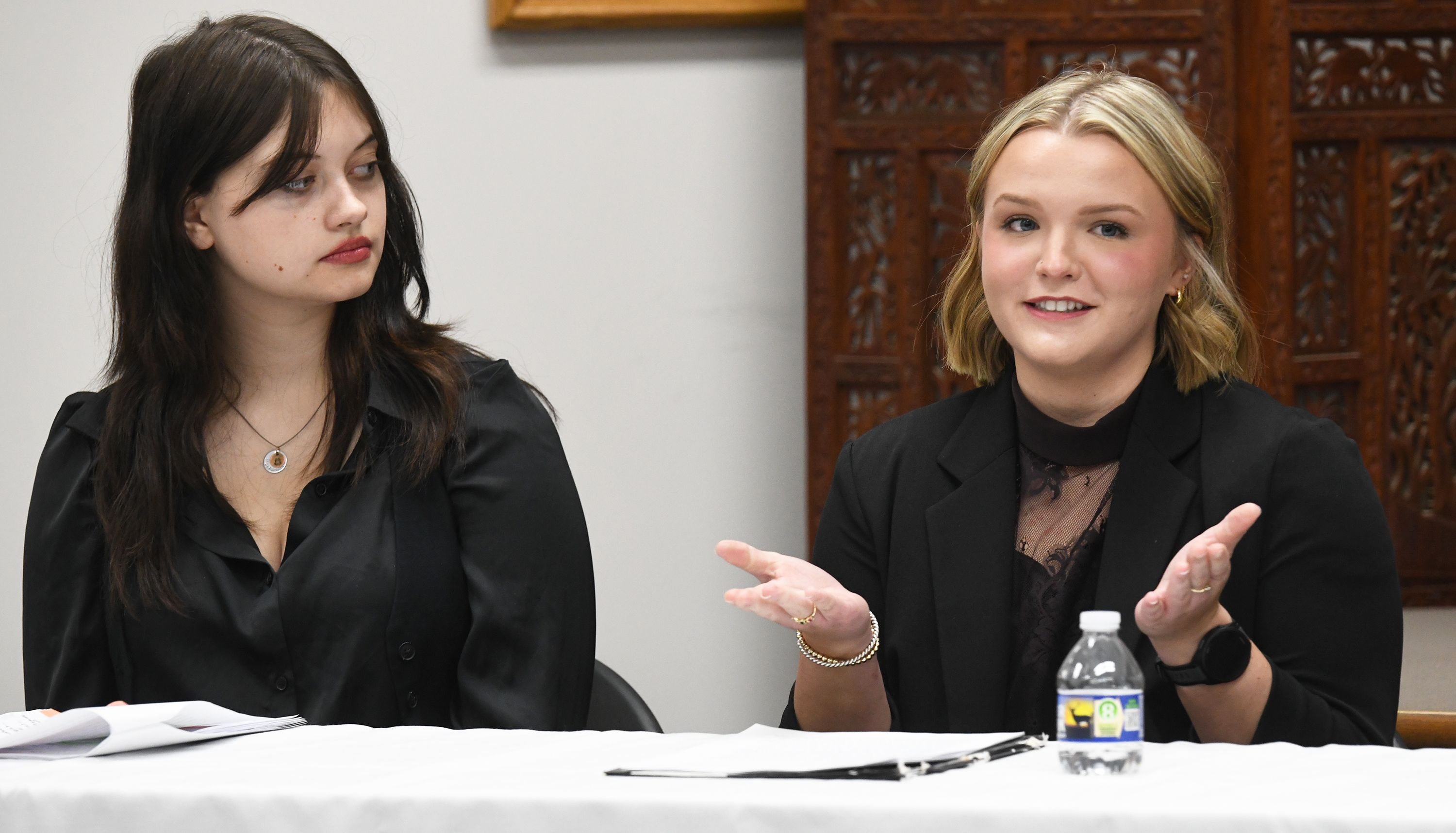
Lindsey Wilson University student Sarai Collins ’28 of Columbia discusses her honors project, “Jennifer’s Body” in “Killing Boys but Never the Male Gaze: A Negotiated Reading of ‘Jennifer’s Body,’” on Tuesday, Nov. 24, in the Thomas D. Clark Reading Room of the university’s Holloway Building. Looking on is Briana Frey ’29 of Breeding, who presented “The Limits of Abuse: The Laws & Ethics Surrounding the Use of Artificial Intelligence in CSAM (child sexual abuse material).” The two were among 17 Lindsey Wilson students who presented research at the R.V. Bennett Honors Program’s 2026 Fall Symposium.
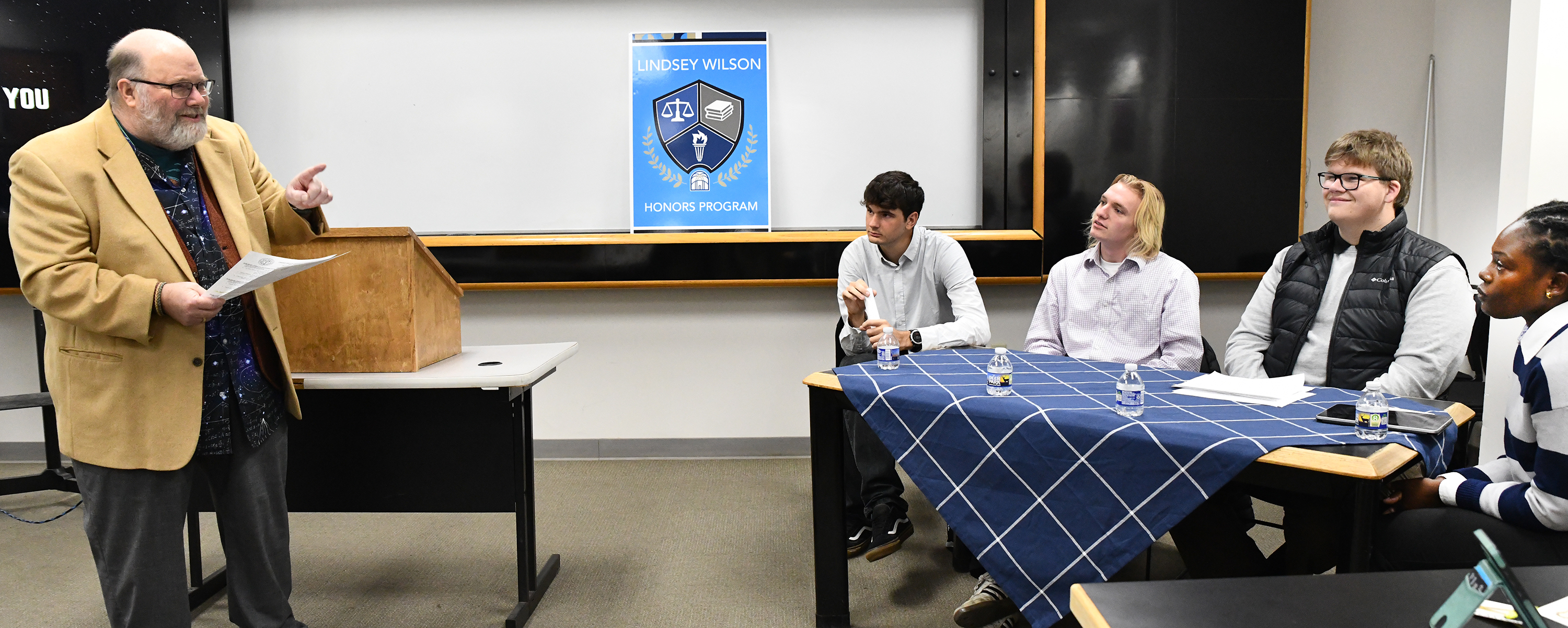
Lindsey Wilson University physics professor Mark McKinnon, left, makes a point to student panelists, from left, Angelo Petris ’29 of Montereale Valcellina, Italy, Zach Hite ’27 of Hodgenville, Kentucky, Jake Weddle ’29 of Liberty, Kentucky, and Stella Kwagala ’27 of Uganda on Tuesday, Nov. 24, in the Keith Stearns Room of the Holloway Building. The four students were among 17 Lindsey Wilson students who presented research at the R.V. Bennett Honors Program’s 2026 Fall Symposium.
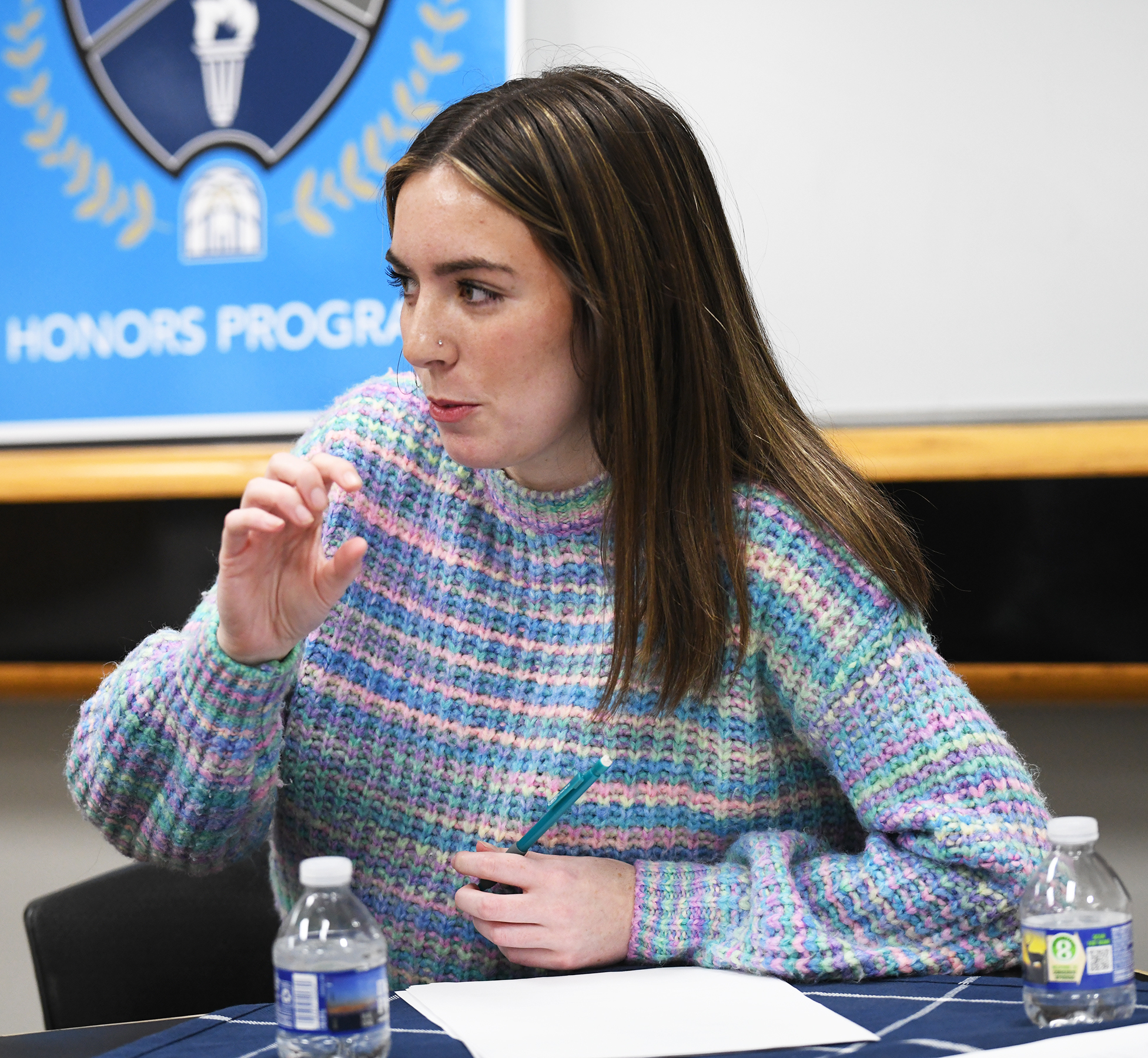
Lindsey Wilson University student Natalie Bartrug ’30 of Russell Springs, Kentucky, makes a point about her research project, “The Historical Reliability of Exodus and Mount Sinai,” on Tuesday, Nov. 24, in the Keith Stearns Room of the Holloway Building. Bartrug was among 17 Lindsey Wilson students who presented research at the R.V. Bennett Honors Program’s 2026 Fall Symposium.
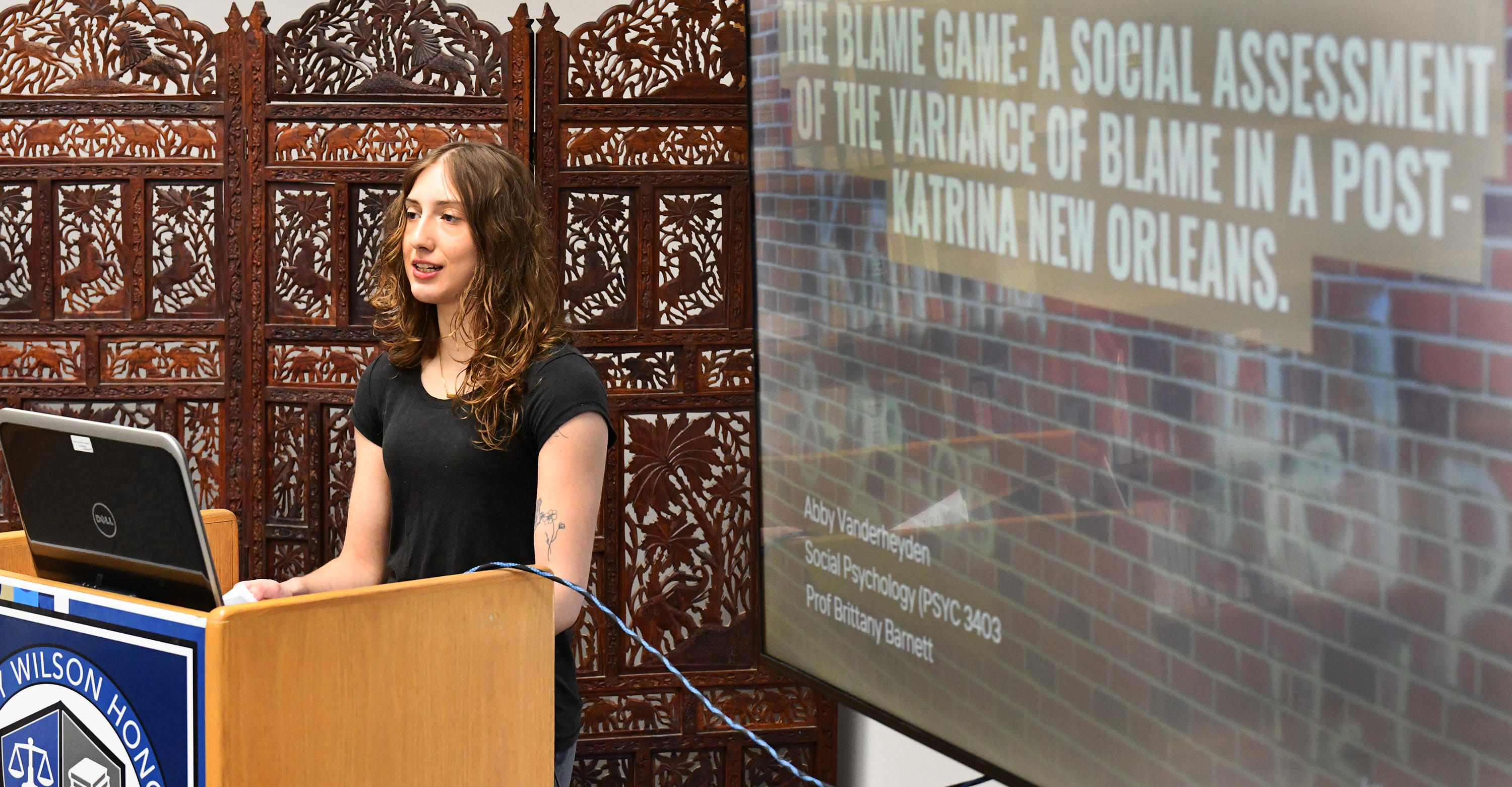
Lindsey Wilson University student Abby Vanderheyden ’28 of Murfreesboro, Tennessee, discusses media coverage of Hurricane Katrina on Tuesday, Nov. 24, in the Thomas D. Clark Reading Room of the Holloway Building. Vanderheyden -- whose project was “The Blame Game: Analyzing Attributions of Responsibility in Katrina Relief Efforts” -- was among 17 Lindsey Wilson students who presented research at the R.V. Bennett Honors Program’s 2026 Fall Symposium.
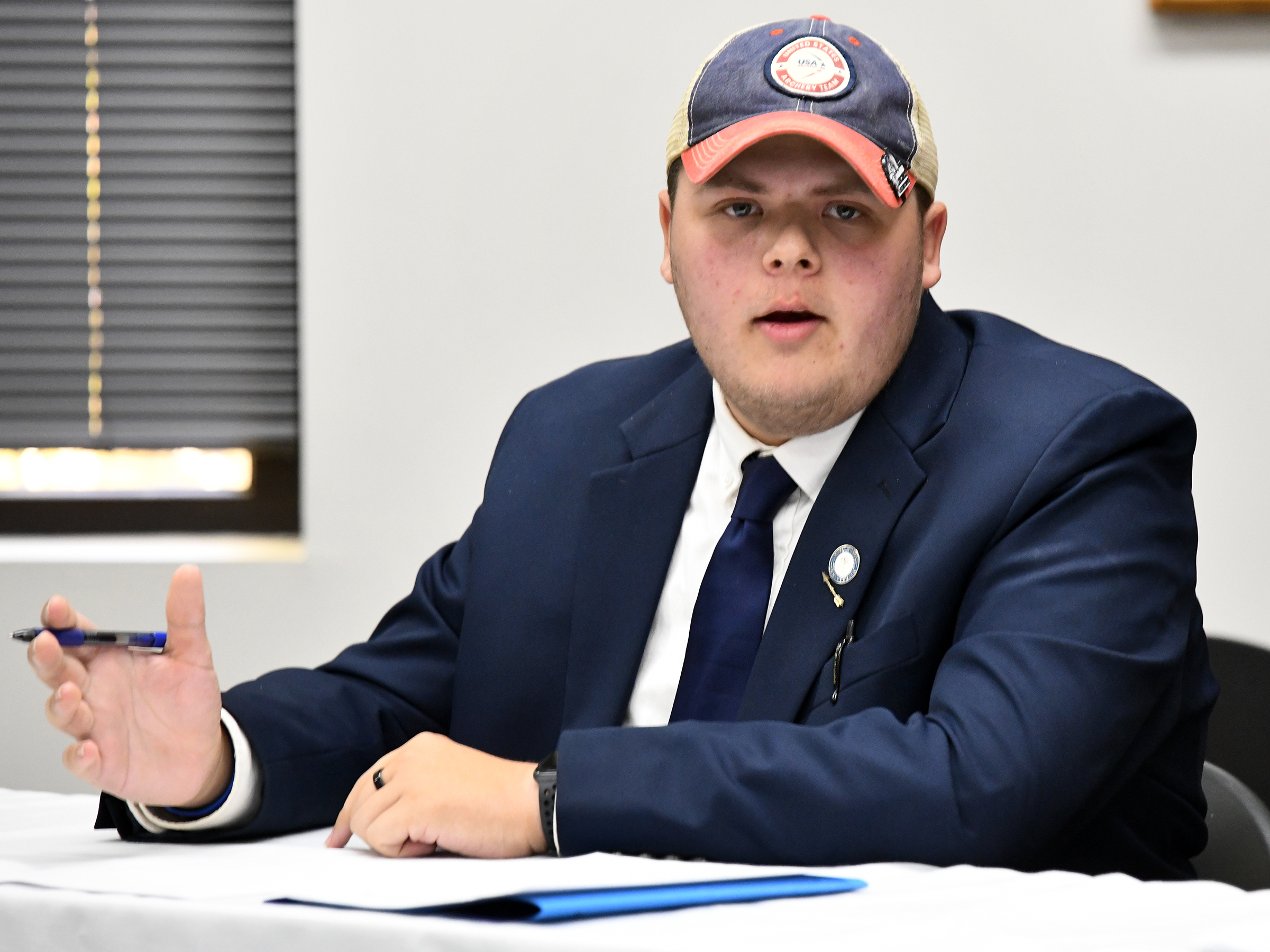
Lindsey Wilson University student Keegan Benton ’29 of Summerville, South Carolina, discusses his research project, “Oura Ring: The Effect of Meditation on Vitals in Precision Sports,” on Tuesday, Nov. 24, in the Thomas D. Clark Reading Room of the Holloway Building. Benton, seen wearing an Oura Ring on his left hand, was the first sport performance major to present research at an R.V. Bennett Honors Program symposium and one of 17 Lindsey Wilson students who presented research at this year’s fall honors symposium.
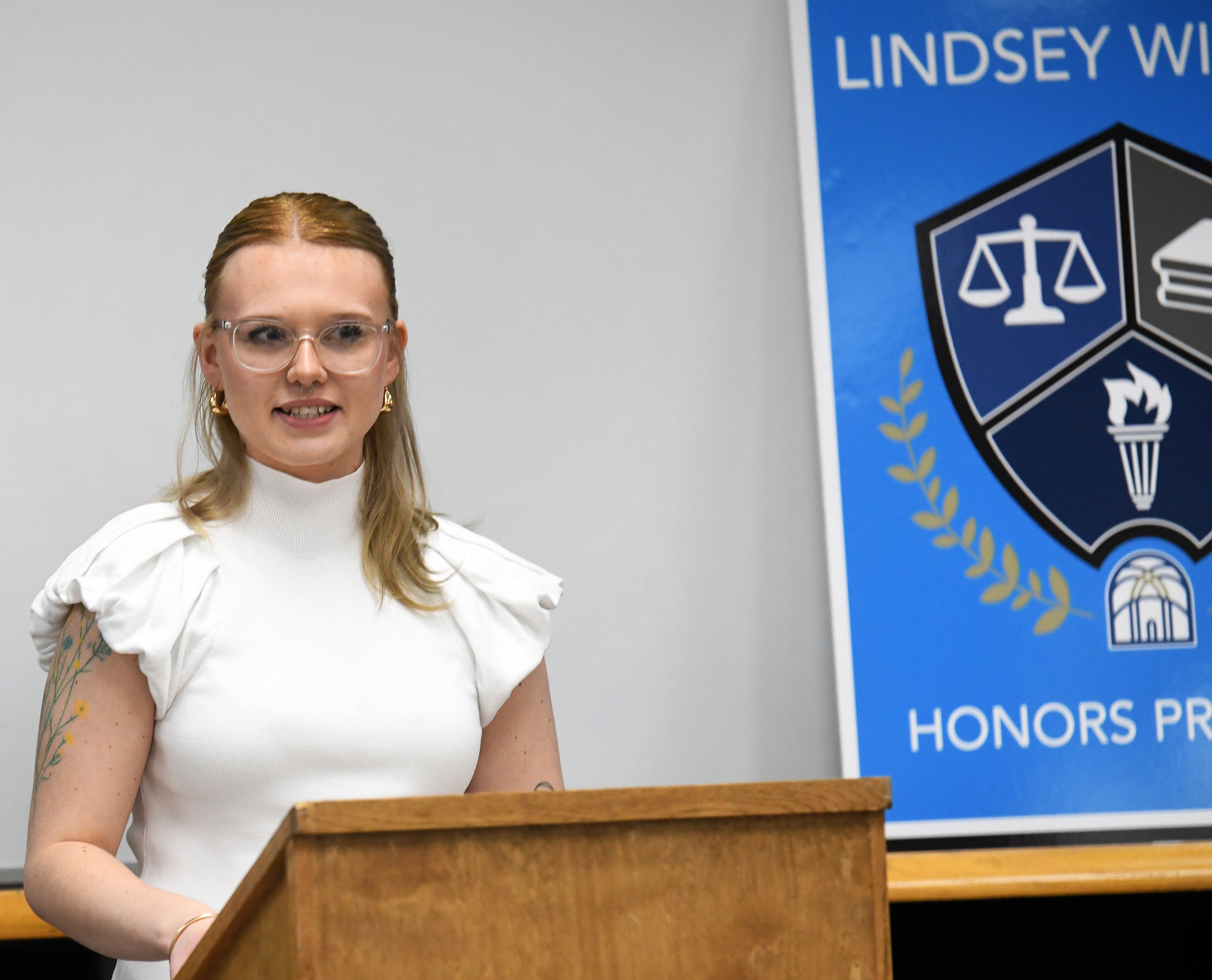
Lindsey Wilson University student Emma Souder ’29 of Eubank, Kentucky, discusses her business idea for “Restore in Peace” on Tuesday, Nov. 24, in the Keith Stearns Room of the Holloway Building. Souder was one of 17 Lindsey Wilson students who presented research at the R.V. Bennett Honors Program’s 2026 Fall Symposium.
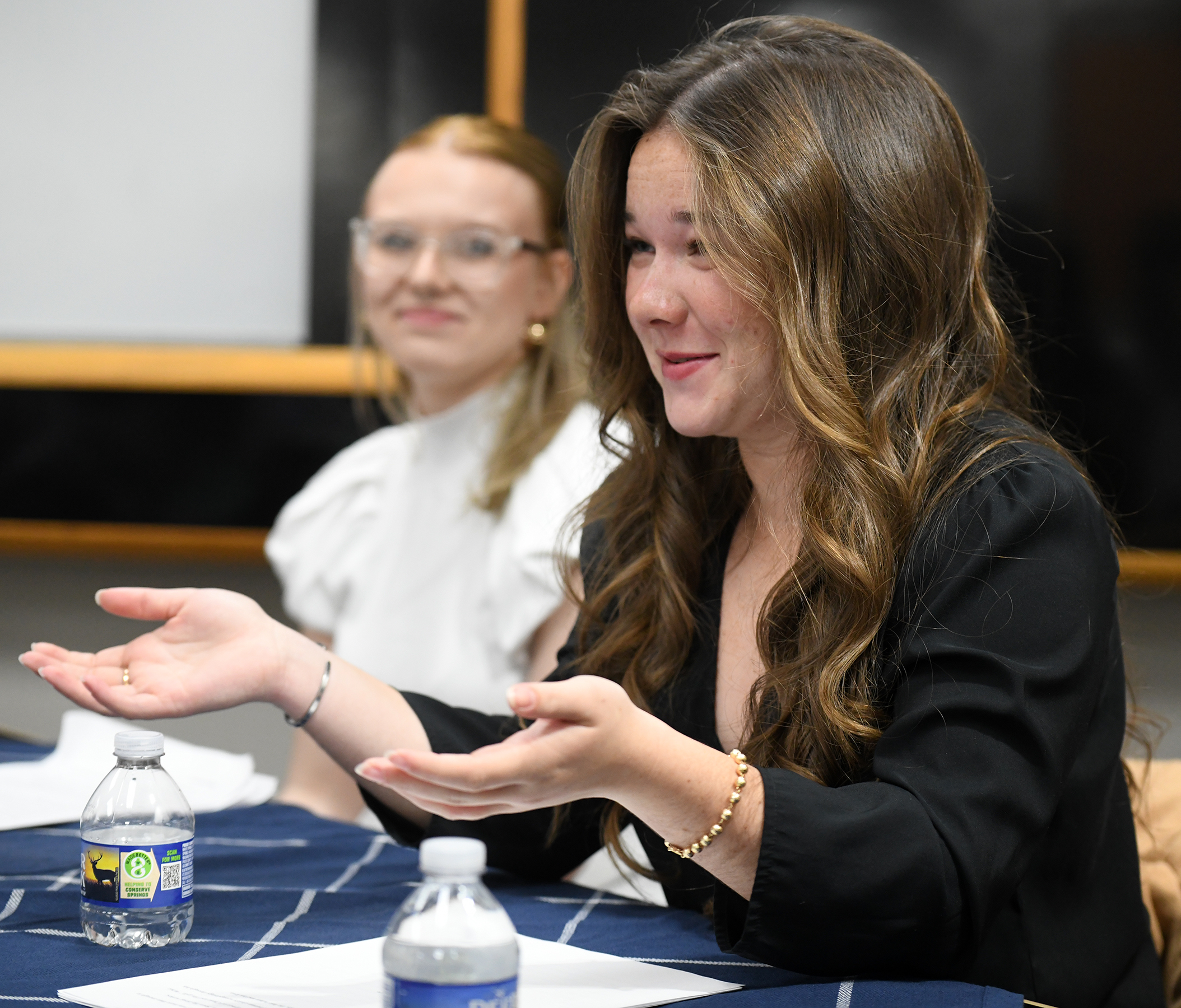
Lindsey Wilson University student Gracie Orr ’30 of Marion, Kentucky, discusses her research project, “The First and Last Adam: Understanding the Parallel Between Adam and Jesus Christ,” on Tuesday, Nov. 24, in the Keith Stearns Room of the Holloway Building. Orr was among 17 Lindsey Wilson students who presented research at the R.V. Bennett Honors Program’s 2026 Fall Symposium.
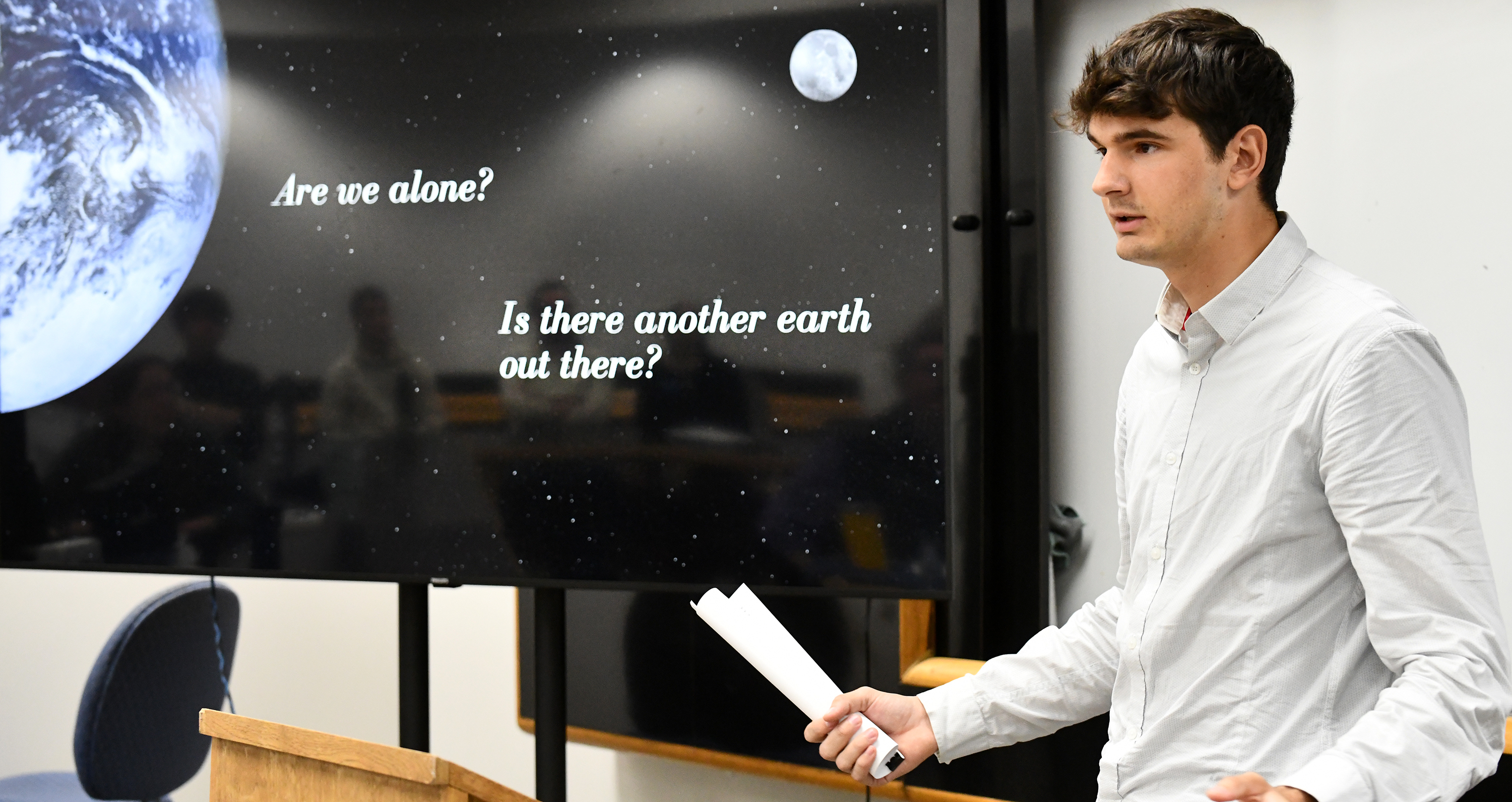
Lindsey Wilson University student Angelo Petris ’29 of Montereale Valcellina, Italy, explains his research project, “Algorithmic Exoplanet Hunting: Automated Transit Analysis and Validation in Kepler and TESS Datasets,” on Tuesday, Nov. 24, in the Keith Stearns Room of the Holloway Building. Petris was among 17 Lindsey Wilson students who presented research at the R.V. Bennett Honors Program’s 2026 Fall Symposium.